
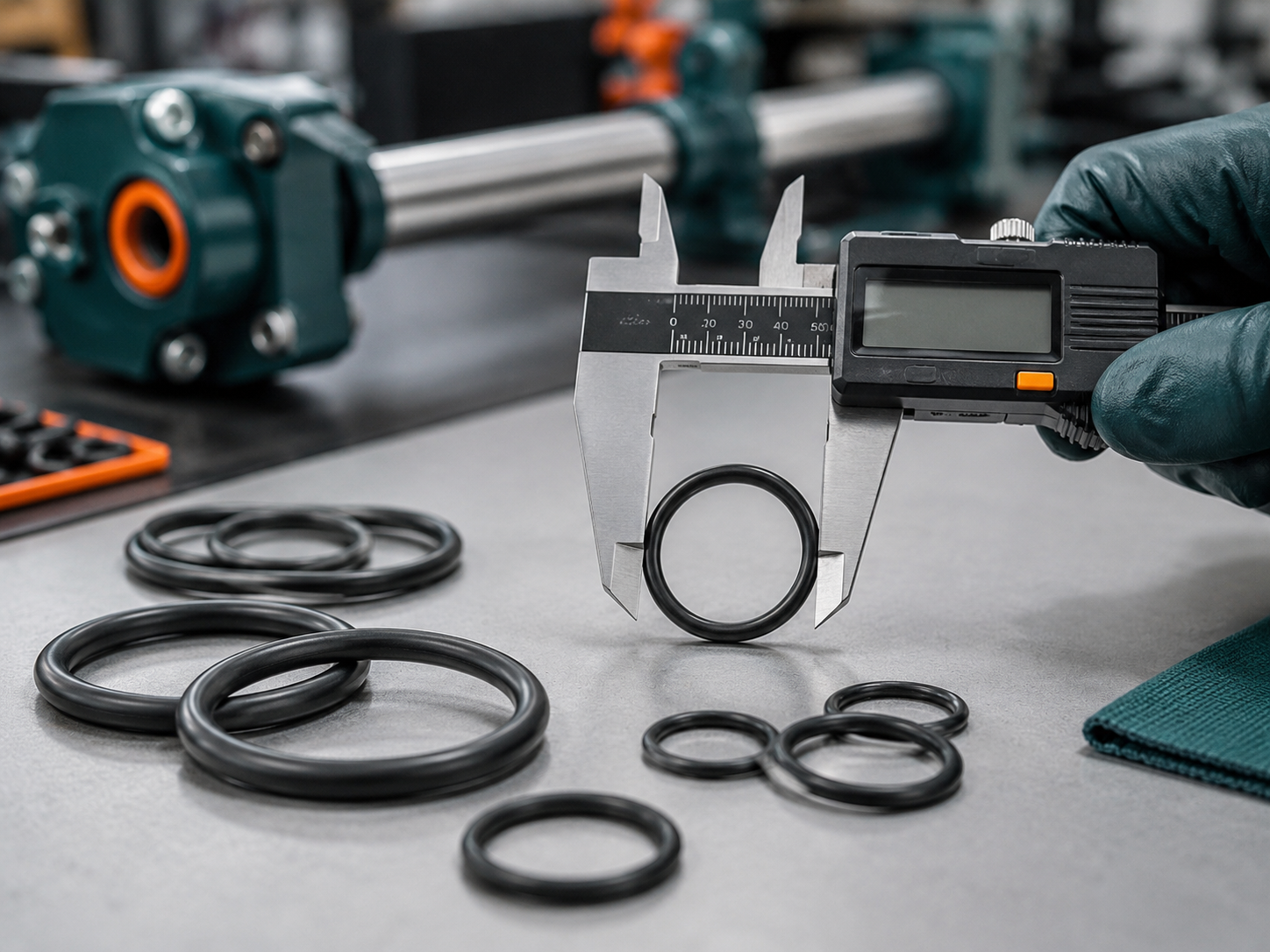
An O-ring is mainly defined by two dimensions: the inside diameter and the cross-section. A used O-ring may have stretched, flattened or permanently deformed in service, so a careful measurement should preferably be checked against the groove or component as well.
1. Measure the inside diameter
Place the O-ring on a flat surface without stretching it. Use a caliper to measure the inside diameter. For very large rings, a cone, diameter tape or other suitable measuring aid may be easier to use.
2. Measure the cross-section
Measure the rubber thickness at several points. A used ring may be flatter on one side, so a single reading can be misleading. A new O-ring should have a nearly uniform circular cross-section.
3. Check the groove
If the old seal is badly worn, the groove dimensions can provide a better reference. Measure groove diameter, width and available space. The O-ring needs enough compression to seal, while still having room to deform safely.
Common mistakes
- Measuring a stretched ring.
- Using only the outside diameter.
- Taking a flattened used ring as the exact original size.
- Ignoring material and hardness.
When in doubt, compare the measured ring with the groove and operating conditions. Pressure, temperature, fluid and movement all influence the correct choice. Hydroseals can help identify a suitable size and material.