
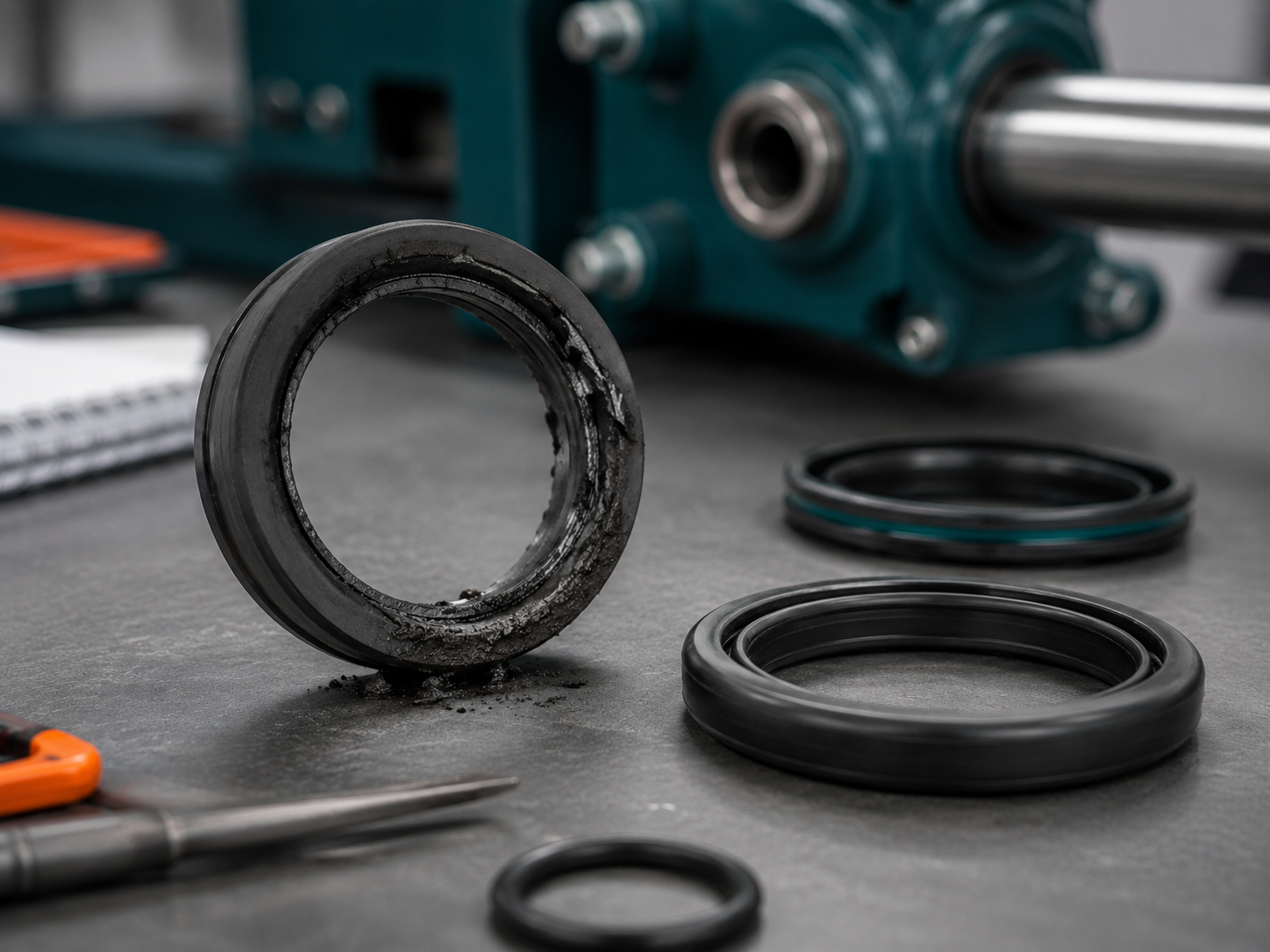
Replacing leaking seals can restore a cylinder, but only when the cause of the original damage is also addressed. The appearance of a failed seal often gives useful clues about what is happening inside the cylinder.
Contamination
Dust, metal particles and dirt act as abrasives. Wipers and guide elements are therefore important, as are clean hydraulic oil and effective filtration.
Damaged rod or bore
Pitting, scratches and sharp damage can cut the sealing lip. A new seal fitted on a damaged rod may start leaking again quickly.
Incorrect size or profile
Too much or too little interference, incorrect groove dimensions or the wrong profile can cause extrusion, excessive friction or inadequate sealing.
Temperature and fluid compatibility
Not every elastomer suits every oil, chemical fluid or temperature. An incompatible material can harden, swell, soften or crack.
Side load and poor guidance
Worn guide rings allow the rod or piston to run off-centre. The seal then carries uneven load and can wear rapidly on one side.
Pressure spikes and extrusion
High pressure and excessive clearance can push sealing material into gaps. Backup rings or a different sealing profile may be needed.
Keep a failed seal long enough to inspect it. Photos, dimensions and information about pressure, temperature and fluid can help identify the root cause. Hydroseals can use these details to help select a more durable solution.